Trusted plumbing experts serving Norman Oklahoma for over 30 years
What’s Covered on This Page
- Decide If You Need Professional Leak Detection Today
- Check Your Water Meter Before You Call
- Why Older Norman Homes and Oklahoma Clay Soil Raise Slab Leak Risk
- How Non-Invasive Leak Detection Finds the Source Without Guesswork
- One Plumber for Detection, Slab Leaks, and Water Line Repair
- Does a plumber fix the leak, or just find it?
- What affects how much a hidden leak costs to fix?
- Is slab leak detection different from checking a regular pipe leak?
Decide If You Need Professional Leak Detection Today
Not every leak needs a detection visit. The real question is simple: can you see where the water is coming from?
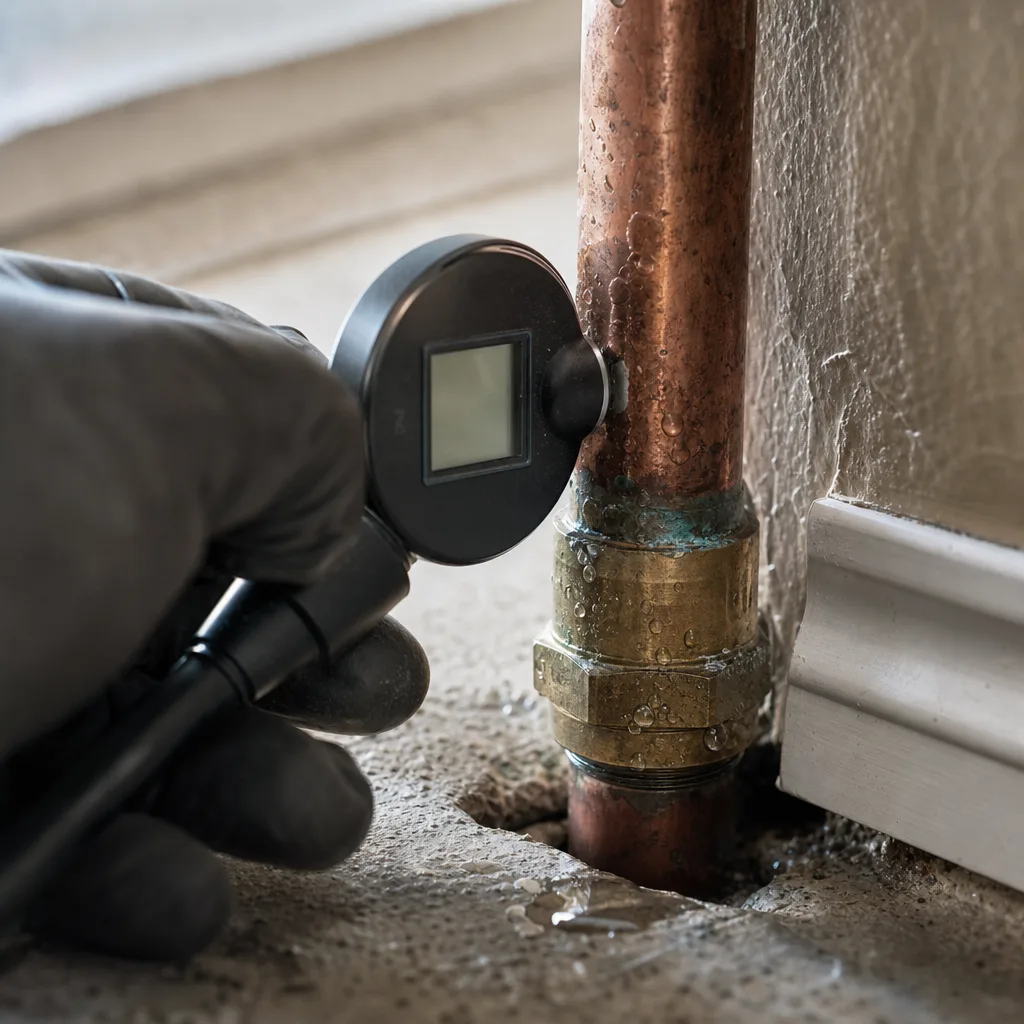
If you can see it, it’s a repair. If you can’t, it’s a detection job first. Guessing at a hidden leak is how folks end up with holes in three walls and the leak still running.
Call us today if you notice any of these:
- A warm or damp spot on the floor, especially if your home sits on a slab
- A water bill that went up even though your habits didn’t change
- The sound of water running or hissing when nothing is turned on
- New stains, bubbling paint, or a musty smell on a wall or ceiling
- A soggy patch in the yard that stays wet between rains
- Flooring that’s cracking, lifting, or feels soft underfoot
Any one of these means water is going somewhere you can’t see. The longer it runs, the more it can soak into subfloor, drywall, or the ground under your slab.
If a pipe has burst or water is pouring in, don’t wait to figure it out. We offer 24/7 emergency service for burst pipes, leaks, and other urgent problems.
Now for the honest part. Here’s when you probably don’t need leak detection at all:
- A faucet that drips from the spout. That’s usually a worn part inside the faucet, not a hidden leak.
- A toilet that keeps running or refills on its own. That’s often a tired flapper you can swap out.
- A drip under the sink at a fitting you can see. Sometimes a snug turn or a new supply line fixes it.
- A one-time puddle by a door after a big storm. That’s more likely weather getting in than a plumbing problem.
Those are real fixes, but they aren’t detection jobs. If you’d rather not deal with them yourself, we handle faucet repair and toilet repair too.
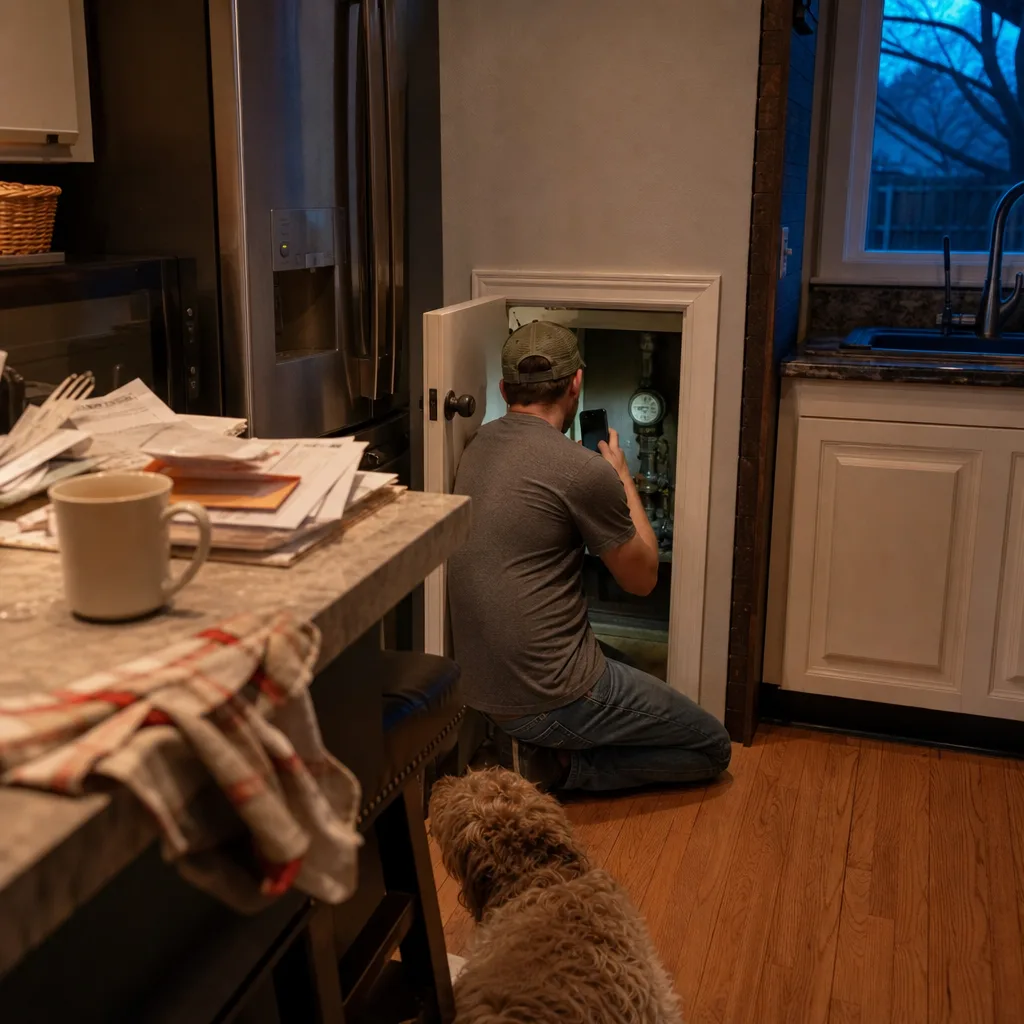
Still not sure? Try this quick check. Turn off every faucet and appliance that uses water. Then find your water meter and write down the reading.
Wait about an hour without using any water, then look again. If the number moved, water is leaving your pipes somewhere.
That check tells you there’s a leak. It doesn’t tell you where. Finding the exact spot is our job, so you only open up the one place that needs fixing.
We give free estimates, so calling to talk through what you’re seeing won’t cost you a thing.
Check Your Water Meter Before You Call
The one-hour reading we mentioned above is a great start. A few extra minutes at the meter can tell you even more. Then when you call, you’ll already know a lot about where the water is going.
Most homes in Norman have the water meter in a covered box near the street or sidewalk. Lift the lid slowly and look before you reach in. Spiders and other critters like to hide in there.
Many meters have a small leak indicator. It’s often a little triangle, star, or wheel on the meter face. It spins when even a small amount of water moves through.
If that indicator is turning while nothing in the house is on, you don’t need to wait an hour. You’ve got water moving right now.
Before you decide it’s a hidden leak, make sure nothing is using water on its own. These can fool you:
- Sprinkler or drip systems on a timer
- A refrigerator ice maker or water line
- A water softener running a cycle
- A washing machine or dishwasher that’s still filling
- A pool or pond with an auto-fill
Toilets are the next thing to rule out. A toilet can leak silently into the bowl all day long. Put a few drops of food coloring in the tank and don’t flush. If color shows up in the bowl after 15 or 20 minutes, the flapper is leaking.
That’s good news. It’s a cheap part, not a hidden leak.
If the toilets pass and the meter still moves, try one more test. Find your home’s main shutoff valve. It’s often in a garage, a utility closet, or where the water line enters the house. Close it, then go back and watch the meter.
Here’s what the results mean:
- Meter stops with the main valve closed: the leak is inside the house, in the walls, floors, or under the slab.
- Meter keeps moving with the main valve closed: the leak is likely in the line between the meter and your house, out in the yard.
- Meter never moved at all: your pipes are probably holding tight, and the problem may be something else.
Don’t force a valve that’s stuck or crusty. Old valves can break if you crank too hard, and then you’ve got a new problem. If it won’t turn easily, leave it and tell us when you call.
Jot down what you found. Note whether the indicator spun, what the toilet test showed, and what happened with the main valve closed. Those notes help us narrow things down faster.
None of this replaces finding the exact spot. It just helps point us toward the right part of your home. That way only the one area that needs fixing gets opened up.
Why Older Norman Homes and Oklahoma Clay Soil Raise Slab Leak Risk
If your meter test pointed to a leak inside the house, there’s a good chance some of your water lines run under your concrete slab. A lot of homes around Norman are built this way. That’s not a bad thing on its own, but it does mean a leak can hide where you can’t see it or reach it easily.
Two things make slab leaks more likely here: the ground your home sits on and the age of the pipes under it.
Much of central Oklahoma sits on clay soil, the kind of expansive clay that swells up when it gets wet and shrinks when it dries out. It doesn’t hold still.
Our weather keeps that cycle going. We get wet springs, hot dry summers, and heavy storms that soak the ground fast. Then a dry spell pulls the moisture right back out.
Each time the soil swells and shrinks, your slab shifts a tiny bit. You won’t feel it. But the pipes locked inside and under that concrete feel every move.
Over the years, that movement can put stress on joints and bends. A pipe can rub against concrete, gravel, or other lines until it wears thin. Sooner or later, a small spot gives way.
Age makes it worse. Pipes don’t last forever, and older homes have had more years of shifting soil working on them.
Here’s what tends to wear down over time:
- Metal pipes can thin out from the inside as water flows through them for decades.
- Spots where a pipe touches concrete or another pipe can wear through from rubbing.
- Joints and fittings can loosen as the slab moves season after season.
- Hot water lines go through heat and cooling cycles every day, which adds extra wear.
A newer home isn’t off the hook, though. The soil moves under new slabs too. Age just gives that movement more time to do damage.
So why does this matter for you right now? Because a slab leak is the one place where guessing costs the most.
Your slab might be one big piece of concrete covering your whole living space. If someone breaks it open in the wrong spot, you’re paying for concrete work, flooring repair, and maybe moving furniture. And the leak is still running.
Water under a slab doesn’t stay put, either. It can soak into the clay and make it swell even more in one area. That can add stress to the foundation around the leak.
That’s why we push so hard on finding the exact spot first. When you know where the leak is, you only open up the one small area that needs fixing. Sometimes the best fix is rerouting the line around the slab so the old pipe never has to be dug out.
If your home sits on a slab and your meter moved with everything off, don’t wait for a warm floor or a cracked tile to tell you more. The sooner the leak is found, the less water ends up under your foundation.
Not sure what your Plumbing Leak Detection project needs? Ask us.
Call for an estimate. Brandon’s Plumbing is ready to help.
How Non-Invasive Leak Detection Finds the Source Without Guesswork
So your meter says there’s a leak, but you can’t see it. The next worry is usually, “Are they going to tear up my house just to find it?”
They shouldn’t have to. Good leak detection works from the outside in. The goal is to narrow the leak down to one small spot before any wall, floor, or slab gets opened.
There isn’t one magic tool for this. Pros in the trade use a few methods together, and each one answers a different question.
- Pressure testing: The plumbing gets split into sections, such as hot lines, cold lines, and the main line, and each one is checked to see if it holds pressure. This shows which line is leaking before anyone looks for where.
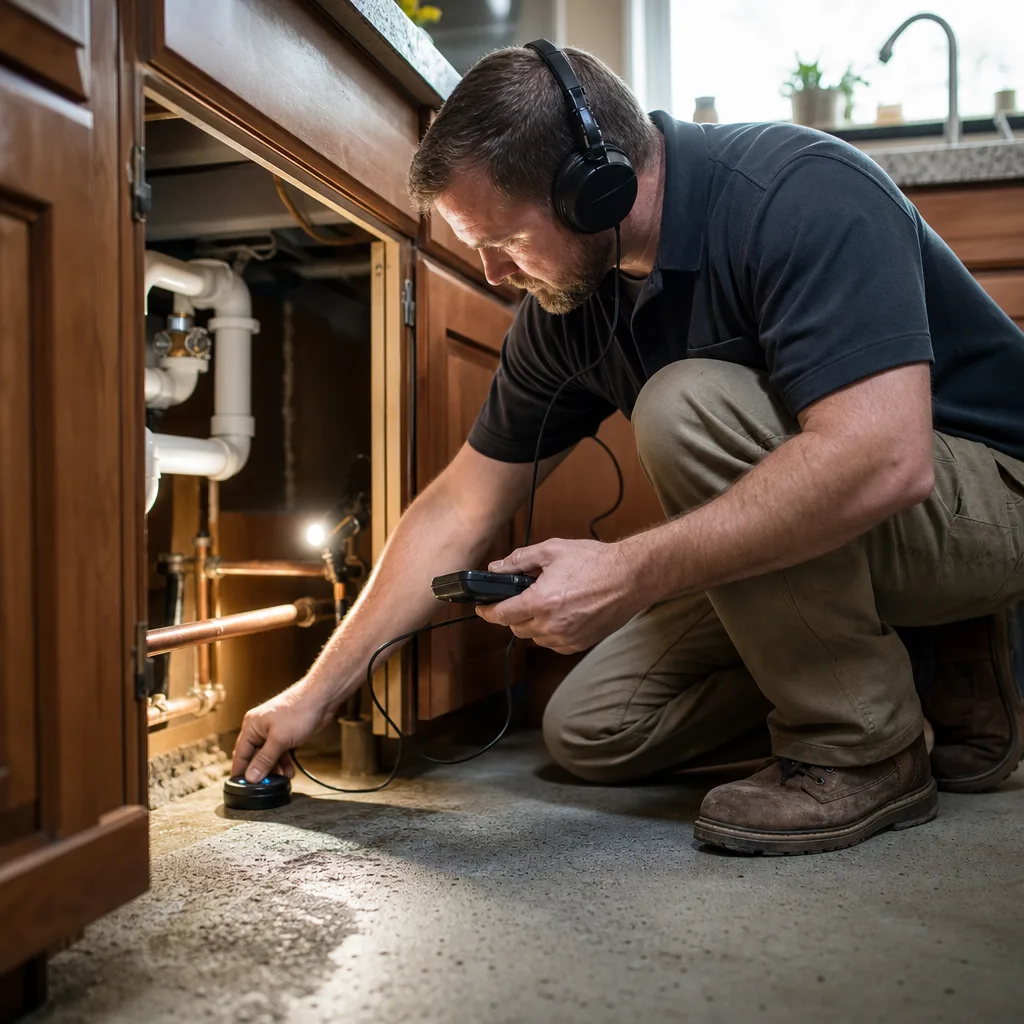
- Listening equipment: Water escaping a pipe under pressure makes a faint hiss or rushing sound. Sensitive microphones can pick that up through concrete, tile, or drywall, and the sound gets louder closer to the leak.
- Thermal imaging: A leaking hot water line warms the floor or wall around it. A thermal camera shows that warm patch as a different color, even when you can’t feel it by hand.
- Pipe locating: Many people don’t know exactly where their pipes run under the slab. Tracing the path of the line keeps the search on track instead of guessing.
- Moisture readings: A moisture meter checks drywall, baseboards, and subfloor for dampness you can’t see yet. It helps show how far the water has spread.
Each method alone has limits. Sound can bounce around under a slab. A warm spot only shows up on hot lines. Used together, they check each other, and the answer gets much more exact.
Here’s a simple example. Say your floor feels warm near the kitchen. A pressure test can confirm it’s the hot line and not the cold one. Thermal imaging can show where the heat is strongest. Listening can then narrow it to a spot about the size of a dinner plate.
That’s the difference between one small, neat opening and a trench across your living room.
Knowing exactly which line failed also helps you choose the fix. A single bad spot might be worth repairing right there. A line that’s worn out in several places might be better rerouted, so the old pipe stays in the slab and you don’t have to dig it out.
If you’re talking to any plumber about a hidden leak, it’s fair to ask a few questions first:
- How will you narrow down which line is leaking?
- Will you mark the spot before anything gets opened?
- If more than one area looks suspicious, how will you decide where to start?
Clear answers to those questions tell you the leak will be found by testing, not by trial and error with a hammer.
Leaks outside the house can be tracked the same careful way. That includes the line between your meter and your home, or a soggy spot in the yard. Drain and sewer problems are a different kind of job. A sewer camera inspection is the right tool when the trouble is in your drain lines instead of your water lines.
Watch Our Video
See How We Handle Plumbing Leak Detection in
Brandon’s Plumbing
One Plumber for Detection, Slab Leaks, and Water Line Repair
Finding the leak is only half the job. The other half is fixing it in a way that makes sense for your home and your budget.
When one company finds the leak and another fixes it, things can slip through the cracks. You explain the problem twice. You wait on two schedules. If the repair crew opens the floor and doesn’t agree with the mark, you’re stuck in the middle.
We handle leak detection, slab leaks, and water line repairs, so you can work with one plumber from the first test to the finished fix. The person who knows where the leak is can also tell you the best way to deal with it.
There’s no set price for fixing a hidden leak, because no two leaks sit in the same spot. Here’s what tends to push the cost up or down:
- Where the leak is. A line inside a wall is usually easier to reach than one under a slab.
- What’s on top of it. Tile, hardwood, or kitchen cabinets over the spot make access harder than bare carpet or an open yard.
- Repair or reroute. Fixing one bad spot can make sense. A line that’s worn in several places may be better replaced with a new path around the slab.
- How long it’s been running. More water under the floor can mean more drying and more damage to deal with.
- Inside or outside. A leak in the yard between your meter and your house means digging, not breaking concrete.
That’s why the exact spot matters so much. A tight mark keeps the opening small, and a small opening keeps the repair bill smaller too.
Before you hire anyone for a hidden leak, it’s fair to ask:
- Does the estimate cover finding the leak, fixing it, or both?
- Will you walk me through repair versus reroute before any work starts?
- What will the area look like when you’re done, and what will I need to fix myself, like flooring or paint?
You should get straight answers in plain words. Honest pricing is something we care about. Our team has more than 30 years of experience, and we’re licensed and bonded.
Our neighbors have noticed, too. We hold an A+ rating with the BBB, and we were named Best Plumber in Moore Monthly’s Best of Moore 2026 awards.
We’re based right here in Norman, on S Sooner Rd. We also serve Moore, Oklahoma City, Edmond, Midwest City, Del City, and other towns around the metro. If water is pouring in or a pipe has burst, we offer 24/7 emergency service.
If you ran the meter test and the numbers moved, you already know something’s wrong. You don’t have to guess where it is or worry about your floors getting torn up for nothing.
Frequently Asked Questions
Common questions about Plumbing Leak Detection
Does a plumber fix the leak, or just find it?
We do both, so you only need to make one call. Once we mark the exact spot, we can repair that section of pipe or reroute the line around your slab, whichever makes more sense for the damage we find.
What affects how much a hidden leak costs to fix?
Several things drive the cost up or down, not a flat rate. Where the leak sits matters, since a line under a slab is harder to reach than one inside a wall. What’s on top of it matters too, because tile or cabinets slow down access more than open carpet. How long the leak has run and whether it needs a simple repair or a full reroute also play a part.
Is slab leak detection different from checking a regular pipe leak?
Yes, slab leaks take extra care because you can’t see or reach the pipe directly. We use pressure testing, listening equipment, and thermal imaging together to narrow the leak down to a small spot before any concrete gets opened, instead of breaking into the slab to search for it.